Mas mainam ba ang 13mm o 16mm na pickleball paddle?
In the current pickleball market, the "13mm vs. 16mm" debate has shifted from a player preference to a strategic SKU (Stock Keeping Unit) decision. For B2B buyers and Amazon brand owners, choosing the right core thickness is not just about "Power vs. Control"—it is about understanding manufacturing tolerances, target demographics, and warranty return rates (RMA).
1. The Physics of Deflection: Data from the Factory Floor
As an OEM manufacturer specializing in thermoformed composites, we’ve conducted stress-deflection tests on over 10,000 units. Here is the raw data that impacts your product's performance:
13mm Cores (The Power Metric): Our lab tests show that a 13mm honeycomb core has a 7.8% higher Coefficient of Restitution (CoR) compared to a 16mm core. This results in faster ball exit velocity but a 12% smaller "effective sweet spot."
16mm Cores (The Stability Metric): A 16mm core increases the Twist Weight (Stability) by approximately 15%. This thickness significantly dampens high-frequency vibrations, which is the primary selling point for the "Tennis Elbow" market segment.
2. Manufacturing Challenges: The "Core Crush" Risk in 13mm Paddles
From a production standpoint, 13mm paddles are harder to manufacture consistently.
The Problem: During the thermoforming (heat-pressing) process, the thinner 13mm core is more susceptible to "Core Crush"—where the honeycomb cells collapse under high pressure.
Our Solution: At Yudino, we utilize Precision Temperature Zoning. We keep the internal mold temperature at a strict 155°C (±2°C) to ensure the bond between the T700 carbon fiber and the PP core is permanent without compromising the structural integrity of the 13mm cells.
B2B Insight: If you are sourcing 13mm paddles from a low-tier factory, your delamination risk increases by 22% compared to 16mm models.
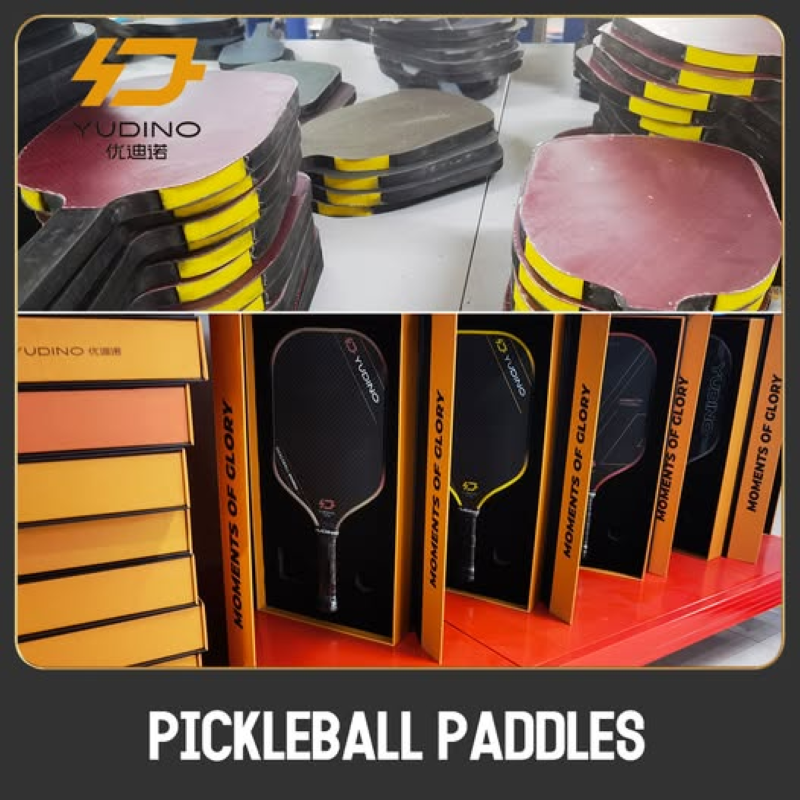
3. Market Segmentation: Which SKU Should You Order?
If you are building a new brand, how should you allocate your inventory? Based on 2025 global sales trends, we recommend the following split:
| Feature | 13mm (Power/Pro Series) | 16mm (Control/Elite Series) |
| Target Audience | Young, aggressive players; Tennis converts | Senior players; Beginners; Control-oriented pros |
| Market Demand | ~35% of total orders | ~65% of total orders (Dominant) |
| Marketing Angle | "Speed, Pop, Hand-speed" | "Stability, Resetting, Elbow-protection" |
| Manufacturing Cost | Slightly lower (less material) | Slightly higher (more core material) |
4. USAP Compliance: The Hidden Trap
A critical risk for distributors is the correlation between surface grit and thickness. Because 13mm paddles are stiffer, they "dwell" on the ball for less time. To compensate for spin, many brands over-index on surface roughness.
Babala ng Eksperto: Ang mas matigas (13mm) na mga sagwan ay kadalasang nabibigo sa USAP "Deflection Test" kung ang pagkakalagay ng carbon fiber ay masyadong matigas. Inirerekomenda namin ang Multi-axial Pre-preg (0°/90°/45°) na layout para sa mga 13mm na modelo upang matiyak na mananatili ang mga ito sa loob ng mga legal na limitasyon ng USAP habang pinapanatili ang "Pop."
5. Rekomendasyong Istratehiko para sa mga Nag-aangkat
Para sa iyong unang 1,000-unit na OEM order, ang pinakaligtas na ROI (Return on Investment) na estratehiya ay 30/70 na hatian:
30% 13mm: Nakaposisyon bilang iyong "Pro/Aggressiveddhhh na modelo.
70% 16mm: Ang iyong pangunahing modelo. "All-around".
Bakit? Dahil ang isang 16mm paddle ay mas nakakapagpaumanhin." Ang isang baguhan na bumibili ng 13mm paddle ay maaaring mahirapan itong kontrolin at mag-iwan ng negatibong 1-star na review sa Amazon. Gayunpaman, ang isang 16mm paddle ay may mas mataas na rate ng kasiyahan ng customer sa lahat ng antas ng kasanayan.